EN
EN

In the world of earthmoving, the question of which machine moves more dirt isn’t just about horsepower—it’s about vector and volume. If you are standing on a massive 2026 construction site, you’ll likely see both a bulldozer and a crawler loader (track loader) working in tandem, but they are playing entirely different roles in the "dirt-moving" economy.
At TOBETER, we focus on maximizing your site’s Return on Investment (ROI). To do that, you need to understand whether your project requires the raw, horizontal force of a dozer or the versatile, vertical capabilities of a crawler loader. Here is the deep dive into which machine truly moves more dirt.
The fundamental difference between these two machines is how they interact with the ground.
A bulldozer is engineered for one specific physical task: tractive effort. Because the dozer’s blade is fixed directly to a massive, low-slung frame, it can focus nearly 100% of its engine’s torque into pushing material forward.
When we talk about "moving dirt" in terms of high-volume site leveling or pioneering a new road, the dozer is the undisputed champion. It moves dirt in a continuous flow. A large dozer doesn’t stop to lift; it simply carves into the earth and drifts a "blade-load" of soil across the site. In a 50-meter push, a dozer can move significantly more Bank Cubic Yards (BCY) per hour than almost any other machine because it never has to wait for a hydraulic lift cycle.
A crawler loader (track loader) is the "Swiss Army Knife" of the dirt-moving world. While it looks like a dozer with a bucket, its geometry is optimized for loading.
If your definition of "moving dirt" includes getting that dirt off the site or into a haul truck, the dozer loses immediately. The crawler loader moves dirt by digging, lifting, and carrying. While it cannot push as much in a single straight line as a dozer, it can move dirt over vertical obstacles, load it into high-sided trucks, and stockpile material in a way a dozer never could.
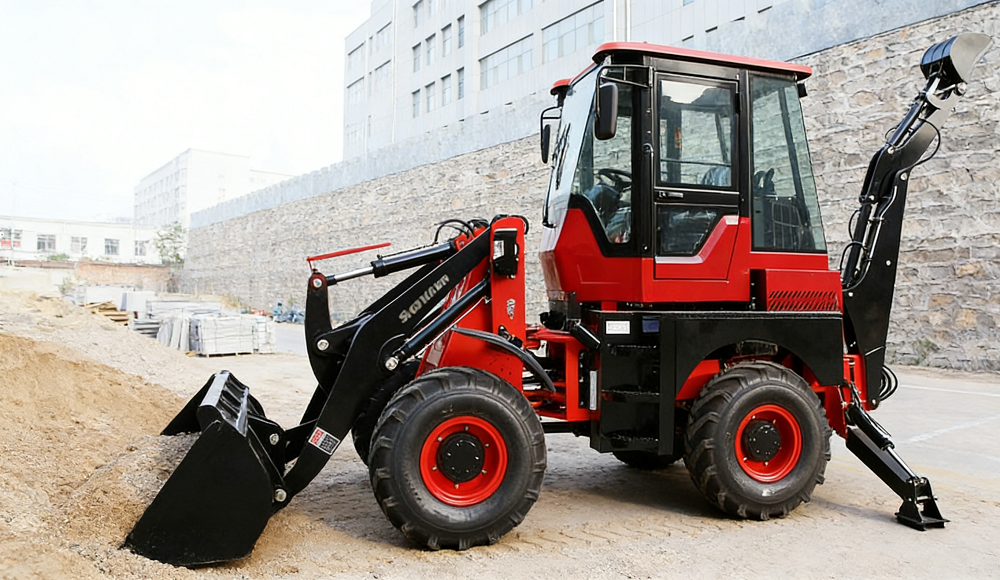
The dozer is your primary machine when the goal is mass redistribution.
Land Clearing: When you need to strip topsoil or push felled trees and stumps into a burn pile, the dozer's blade capacity and lower center of gravity allow it to clear acres of land faster than a loader.
Long-Distance Pushing: In "slot dozing" (where the blade stays in a trench to prevent dirt from spilling off the sides), a dozer can move a massive amount of material over distances of 60 to 100 meters.
Finishing and Grading: With modern 2026 GPS-integrated grade control, a dozer doesn't just move dirt; it moves it to within a millimeter of the final design, reducing the need for rework.
The crawler loader is your primary machine when the site is congested or multi-dimensional.
Excavation and Loading: If you are digging a basement or a foundation, the crawler loader moves more dirt because it performs two jobs at once. It digs the hole and simultaneously moves that dirt into a truck or onto a remote stockpile.
The "One-Machine" Fleet: On smaller 2026 residential sites, a crawler loader often moves more dirt simply because it’s the only machine on-site. It can do the rough grading of a dozer and the material handling of a forklift.
Soft Ground Stability: Because the crawler loader’s weight is distributed over wide tracks—similar to a dozer—it can move dirt in muddy conditions where a wheeled loader would sink. This allows you to keep moving dirt on days when the weather would otherwise shut down production.
To truly answer which moves "more," we have to look at the math.
Dozer Production: Measured by the size of the blade and the speed of the push. A large dozer can move roughly 300 to 800 cubic yards per hour depending on the distance of the push.
Crawler Loader Production: Measured by Cycle Time. This is the time it takes to dig, turn, travel, dump, and return. A high-efficiency loader in a "V-pattern" loading cycle can move roughly 200 to 500 cubic yards per hour into trucks.
In modern fleet management, the question isn't "Either/Or"—it's "How they work together."
At TOBETER, we advocate for the Push-and-Load method. You use the Dozer to perform the heavy stripping and pushing, creating massive "stockpiles" of loose material. Then, you bring in the Crawler Loader to load that loose material into trucks. By specializing the machines, you move 30% more dirt than you would by trying to make one machine do both tasks.