EN
EN

In the competitive landscape of 2026 construction, the digger loader (backhoe loader) remains the industry's most successful "hybrid." While specialized machines like excavators or wheel loaders dominate in single-task high-volume scenarios, the digger loader’s value lies in its dual-function geometry.
At TOBETER, we see this machine as a project manager’s secret weapon—a single asset that can arrive on a raw site, excavate a complex foundation, and then transition to backfilling and grading before the next shift starts. Here is a deep dive into the high-precision world of digging and loading.
The rear of the machine is where the "digger" (backhoe) earns its name. Unlike a front shovel that pushes material away, a backhoe is designed to pull material toward the machine. This "draw" action allows for far greater leverage and "breakout force" when cutting through compacted clay, frozen ground, or rocky soil.
The backhoe consists of three main components that mimic the human arm: the boom (the shoulder), the dipper stick (the forearm), and the bucket (the hand). In 2026, TOBETER-spec machines often feature extendable dipper sticks, allowing a standard unit to reach depths of up to 20 feet without repositioning the tractor.
The true magic of the backhoe is its swing power. Mounted on a pivot that typically allows for a 180-degree to 200-degree arc, the machine can dig a trench and deposit the spoil pile to the side without ever moving its tires. This is a critical advantage in narrow utility corridors or urban sites where space for a separate haul truck is non-existent.
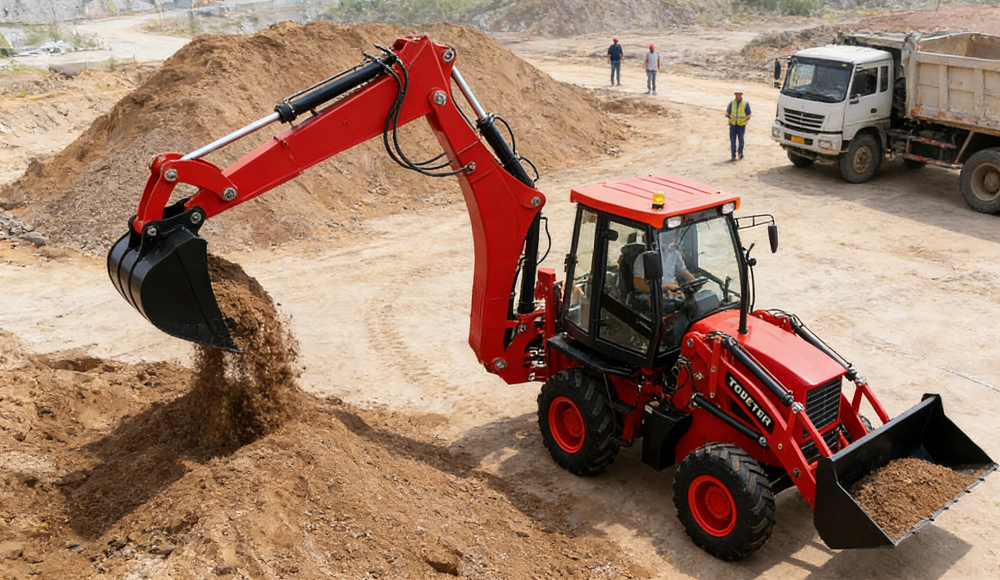
When the operator rotates their seat 180 degrees, the machine undergoes a total personality shift. The front-end loader is the "muscle," designed to move large volumes of loose material, debris, or aggregates with high-speed efficiency.
The front bucket is significantly wider than the rear bucket, usually holding between 1.0 and 1.5 cubic yards.
The Loading Cycle: A skilled operator uses the machine's tractive effort to penetrate a pile, then "curls" the bucket upward to capture the load. Modern hydraulics allow for "compound movements," meaning you can lift the arms while simultaneously curling the bucket, shaving seconds off every cycle.
Grading Excellence: By placing the loader bucket in the "float" position, the machine uses its own weight to scrape and level a site. This is how a digger loader finishes a job—by smoothing out the very ruts it created while digging.
One of the most misunderstood functions of a digger loader is the use of stabilizer legs (outriggers). You cannot perform high-precision digging while sitting on rubber tires; the machine would bounce, losing all hydraulic accuracy and potentially tipping.
Before the first scoop of the rear bucket, the stabilizers are lowered to lift the rear wheels slightly off the ground. This transfers the massive digging forces—which can exceed 15,000 lbs of force at the bucket teeth—directly into the earth rather than through the tire's suspension. It creates a rigid, stable platform that allows the operator to feel the ground through the joysticks, ensuring they don't strike hidden utility lines.
In 2026, the efficiency of a TOBETER digger loader is driven by Closed-center Load Sensing Systems (CLSS). This "smart" hydraulic brain senses the resistance the bucket faces and directs exactly the right amount of oil flow to that specific cylinder.
This means that if you are digging through soft sand, the machine moves at maximum speed. If you hit a buried rock, the system instantly shifts from speed to maximum torque, providing the breakout force needed to dislodge the obstacle without stalling the engine. This intelligence results in a 20% fuel savings compared to the "always-on" hydraulic systems of the past decade.
In an era of rising fuel costs and labor shortages, the ability to drive a single machine to a job site at 25 mph is a massive economic advantage. You save on a dedicated transport trailer, a heavy-duty truck, and a second operator. The digger loader is the "first responder" of construction. It is small enough for residential driveways but powerful enough for municipal water line repairs. By mastering the transition between the precision of the backhoe and the raw capacity of the loader, a single operator can manage an entire project footprint alone. At TOBETER, we don't just build diggers; we build the iron that keeps your project moving forward.